
Half-Term Is Not a Luxury. It’s Nervous System Recovery.
Feb 27, 2026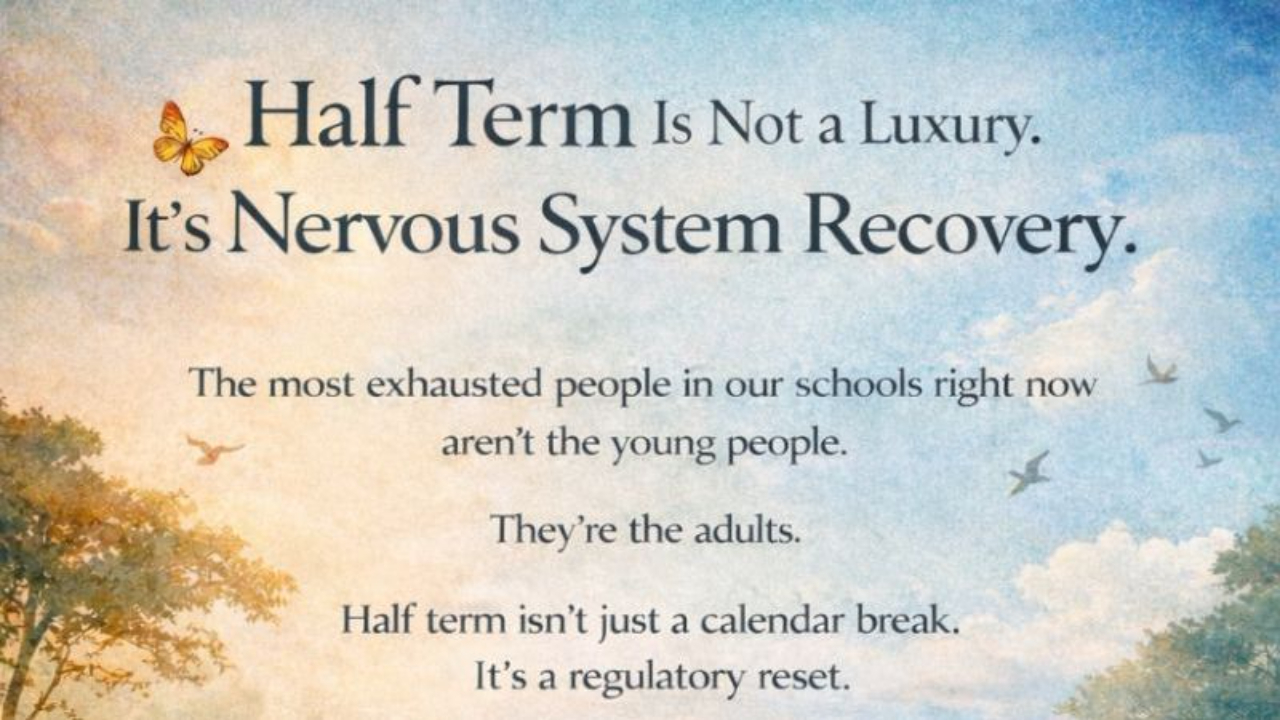
Right now, the most exhausted people in our schools aren’t the young people.
They’re the adults.
The teachers holding emotional dysregulation in classrooms.
The safeguarding leads carrying complex disclosures.
The support staff absorbing distress.
The leaders balancing accountability with humanity.
Half-term isn’t just a calendar break.
It’s a regulatory reset.
The Hidden Load Adults Have Been Carrying
In trauma-informed systems, we often speak about co-regulation.
We remind staff to be the calm in the storm.
To steady the tone.
To hold boundaries with warmth.
To absorb heightened emotion without escalating.
But we rarely pause to acknowledge this:
Adults have been holding a lot this term.
Holding:
-
Heightened behaviour
-
Complex safeguarding concerns
-
Emotionally dysregulated moments
-
Worried parents
-
Accountability pressures
-
Team wellbeing
That level of sustained emotional labour carries a physiological cost.
When stress is prolonged and recovery is insufficient, the nervous system adapts for survival, not flexibility.
According to Stephen Porges (2011) and Polyvagal Theory, chronic stress reduces cognitive flexibility and narrows our window of emotional regulation. We become more reactive, less patient, less creative.
Burnout research by Maslach & Leiter (2016) further highlights that sustained emotional demand without adequate recovery increases exhaustion and reduces professional efficacy.
In simple terms:
When adults don’t get recovery time, their capacity shrinks.
Rest Is Not Indulgent. It Is Preventative.
We often treat rest as something to be earned.
As a reward for productivity.
As a luxury once everything is done.
But nervous systems don’t work like that.
Recovery is not a bonus feature.
It is a biological requirement.
Without it:
-
Decision-making quality declines
-
Emotional regulation narrows
-
Compassion fatigue increases
-
Cynicism grows
-
Mistakes become more likely
With it:
-
Perspective widens
-
Flexibility returns
-
Patience deepens
-
Creativity re-emerges
Rest protects professionalism.
How to Use Half Term as True Recovery
This week doesn’t need to be optimised.
Instead of productivity, consider regulation.
-
Slow your pace
-
Reduce decision load
-
Lower expectations of yourself
-
Move gently
-
Sleep without guilt
-
Spend time in environments that feel safe, not stimulating
Let your nervous system downshift.
That might mean long walks.
Quiet mornings.
Switching off notifications.
Saying no more often than yes.
It may feel unfamiliar at first — especially if you’re used to running on adrenaline.
But downshifting is how sustainability is built.
Psychologically Safe Schools Require Regulated Adults
If we want psychologically safe schools, we need regulated leaders and supported staff.
Young people cannot borrow calm from adults who have none left to lend.
Teams cannot sustain compassion without collective recovery.
Half-term is not time off from responsibility.
It is time invested in sustainability.
Culture Is Built in the Pause
We often talk about culture in terms of systems, strategy, and vision.
But culture is also built in the pause.
In whether leaders model boundaries.
In whether staff feel permitted to rest.
In whether recovery is normalised or quietly judged.
If we want schools that don’t just survive but thrive, we must treat rest as infrastructure — not indulgence.
And that includes you.
So this week, let the pace soften.
Because the work you do matters deeply.
And it can only continue well if you are well enough to do it.
